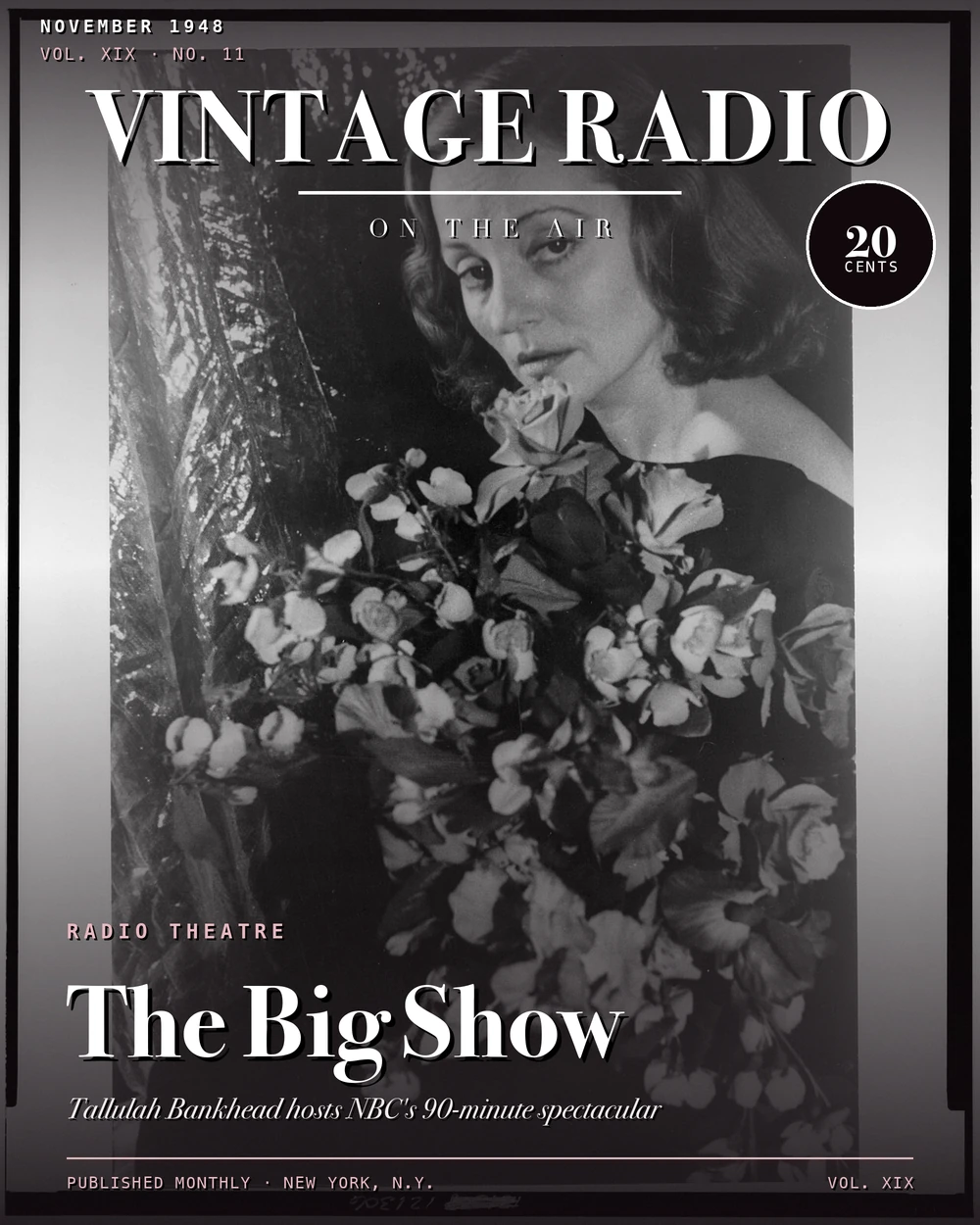
The Big Show
NBC's Last Big Swing
By November 1950, NBC was in trouble. CBS had successfully poached Jack Benny and most of NBC's old Sunday lineup, and the peacock network needed a dramatic answer. What they came up with was The Big Show — a 90-minute Sunday evening variety program that would stack more star power into a single broadcast than anyone had attempted before. NBC executive Sylvester "Pat" Weaver, who was simultaneously managing NBC's growing television operation, conceived the project and branded it "NBC's Sunday Spectacular at Six." Historian Jim Ramsburg described the show as Weaver's "biggest and most expensive blunder in Network Radio." Whether that verdict is fair or not, it's hard to argue the show's business logic worked out.
The network estimated the cost at $300 per minute of broadcast time — a figure that was likely an underestimate. Some individual episodes ran to $100,000. Newsweek called the per-episode cost "real television money," and in the same breath described the show as "the biggest bang to hit radio since TV started." NBC was spending television-scale dollars on a medium that television was actively displacing. Even with that contradiction baked into its premise, The Big Show ran for two seasons and 57 episodes, from November 5, 1950 to April 20, 1952.
The show also pioneered something that outlasted it by decades. It was the first program presented under NBC's new "Operation Tandem" sponsorship plan — marketed as the "Five Show Festival" — which allowed multiple sponsors to share a single program slot. Prior to this, radio programs typically featured one sponsor per time slot. The multi-sponsor participation model The Big Show introduced eventually became standard practice across the entire industry.
The Woman Who Ran It
The show's most important decision was casting Tallulah Bankhead as mistress of ceremonies. Bankhead — born Tallulah Brockman Bankhead in Alabama on January 31, 1902 — was a celebrated stage actress who had never hosted an ongoing radio program before. She took the job out of financial need, according to her own memoirs, but nearly turned it down when she worried she'd just be a glorified introducer. Her concerns were understandable. Structuring 90 minutes of variety radio around a host who also participated in sketches and banter required more than the standard emcee formula.
What emerged was something closer to a personality-driven ensemble show. Bankhead's familiar drawled "dahhhl-ing," her wit, and her genuine willingness to spar on air with guests gave the show a center it might otherwise have lacked. The opening format each week had guests introduce themselves in alphabetical order, with Bankhead closing the roll call with her signature line: "And my name, darlings, is Tallulah Bankhead." In her memoirs, she described her eventual role in less modest terms: "Your heroine emerged from the fracas as the Queen of the Kilocycles. Authorities cried out that Tallulah had redeemed radio."
Fred Allen appeared in regular support and served an additional function behind the scenes. Allen, a longtime friend of head writer Goodman Ace, is credited by radio historian Gerald Nachman as the show's unofficial script doctor. A rotating group of comedians from NBC television programs — Allen, Jack Carson, Ed Wynn, and Jimmy Durante — gave the show a reliable comic core around which the weekly guest lineup rotated.
The Talent Roster
The show's title reflected its explicit ambition: each week's lineup would include the biggest names in show business, drawn from music, drama, comedy, stage, motion pictures, and concert performance. On that front, the booking was genuinely impressive. Regular or recurring guests included Jimmy Durante, Ethel Merman, Frankie Laine, Jose Ferrer, Paul Lukas, Danny Thomas, Groucho Marx, Jane Powell, Fanny Brice, Ezio Pinza, Bob Hope, Eddie Cantor, Rudy Vallee, Danny Kaye, and Judy Garland. The Christmas episode on December 24, 1950, alone featured Bert Lahr, Ed Wynn, Margaret O'Brien, Édith Piaf, and Robert Merrill.
Over the two-season run, the guest list extended to Laurence Olivier, Vivien Leigh, Marlene Dietrich, Ethel Barrymore, Josephine Baker, Yul Brynner, Louis Armstrong, Ginger Rogers, Peggy Lee, Rosalind Russell, Gloria Swanson, and Phil Silvers, among many others. The format also included dramatized scenes from top New York stage productions performed by their original cast members, and Ethel Merman appeared multiple times recreating scenes from Call Me Madame, a Broadway production NBC was fifty percent financially invested in.
The November 26, 1950 episode took the cast to the fictitious Duffy's Tavern, where Ed Gardner appeared in character as Archie the manager. Fred Allen and Bankhead regularly staged a recurring parody called "Mr. and Mrs. Breakfast Show," sending up the sentimental husband-and-wife morning radio format that had been popular a decade earlier. The writers — Goodman Ace as head writer, alongside Selma Diamond, George Foster, Frank Wilson, and Mort Greene — actively worked to find unifying dramatic threads that would prevent the show from feeling like a string of unrelated segments. Wilson specialized in adapting movie scripts and short stories for the dramatic portions. Ace took the head writer job for $750 a week because it was considered NBC Radio's prestige project; he had previously created the long-running comedy series Easy Aces and was described by Fred Allen as "America's greatest wit."
How the Week Worked
Producing 90 minutes of live variety radio every Sunday required a full week's labor. Producer-director Dee Engelbach started planning the next episode at 7:30 PM on Sunday night — immediately after the current broadcast went off the air. He spent Sunday evening with the writing staff searching for a unifying premise, a process that could take several hours. Monday brought meetings with support staff, open idea sessions, and rough sketch drafts from the writers. Meredith Willson was consulted on Mondays about the musical segments.
Guest stars arrived Wednesday and Thursday to work through their routines. The first full rehearsal was held on Friday. Willson — who led the orchestra and chorus — rehearsed the musical guests in a session that could run three hours, followed by dialogue rehearsal, cutting, revision, and further rehearsal, adding another five hours. Sunday brought an integrated all-day rehearsal before the live broadcast from the Center Theatre in New York's Radio City complex. Some editions originated from Hollywood, where announcer Jimmy Wallington substituted for New York-based Ed Herlihy.
Willson was more than a bandleader. Born Robert Meredith Willson in Mason City, Iowa, on May 18, 1902, he had previously served as musical director for NBC's Good News and for the George Burns and Gracie Allen program. He had a recurring comic routine on The Big Show — beginning replies to Bankhead's questions with "Well, sir, Miss Bankhead" — and contributed original compositions. On December 31, 1950, the ninth episode, he premiered "The Iowa Fight Song" before a national New Year's Eve audience, performed by a 47-piece orchestra and sixteen singers. He also wrote the show's closing theme, "May the Good Lord Bless and Keep You," inspired by his mother's parting words to her Sunday school class. The song became Willson's biggest commercial hit, subsequently recorded by Bing Crosby, Gene Autry, Frankie Laine, and Tammy Wynette, among others. Each week the show closed with every guest singing a line from the song, followed by Bankhead wishing "Godspeed" to American armed forces worldwide, who heard the program through the Armed Forces Radio Service.
What It Cost and What It Won
Despite the press coverage, the critical attention, and the Newsweek superlatives, The Big Show made almost no dent in the ratings of the programs it was created to compete against. The Jack Benny Program and The Charlie McCarthy Show, both of which CBS had recently acquired, continued performing consistently well throughout The Big Show's run. The premiere week drew a disappointing 5.7 rating. Over two seasons, the show never placed in the top 20 radio programs and finished last in its 90-minute time slot. NBC, unable to attract enough sponsors to break even, treated the entire program partly as a commercial promoting its own products — including RCA television sets.
For the second season, NBC launched with one of the most lavish publicity stunts the industry had seen: the entire cast flew to Europe to perform in London and Paris. The British press was not impressed. The Daily Express called it "90 minutes of bad jokes, tuneless songs, witless dialogue, soapy compliments, and onion-under-the-nose emotion." Fred Allen quipped that French currency was "the thinnest paper you'll ever see in public." By the time the second season ended on April 20, 1952, NBC had reportedly lost $1 million on the show. Goodman Ace later joked about the competition in a 1970 interview: "We stayed at home on Sunday night and listened to Our Miss Brooks, Jack Benny and Amos & Andy on CBS, just like everybody else."
Press reviews were generally warm throughout the run, though critics periodically asked the same question a fan magazine posed at the end of the two-year run: "Do big names mean good radio?" The show often sounded, despite its stated intentions otherwise, like a star-laden benefit broadcast. Dee Engelbach moved on to attempt a television version of the format with All-Star Revue, which debuted October 11, 1952, with Bankhead among the rotating hosts; it was nominated for Emmy Awards but was also short-lived. Bankhead continued with it until April 18, 1953.
All 57 episodes of The Big Show — 27 from the first season and 30 from the second — survive in recorded form. Martin Grams, Jr.'s 2019 book The Big Show: Tallulah Bankhead and Her Radio Career covers the series in full, including never-before-published photographs and a reprint of Bankhead's 1950 talent contract with NBC. The second-season timeslot shift, from 6:00–7:30 PM Eastern to 6:30–8:00 PM Eastern, was among the adjustments that couldn't change the fundamental ratings picture. What the show did change, permanently, was how networks sold advertising time — and that, more than any single broadcast, is what it left behind.